Preparing your Quilt for Longarming
What should you be aware of in preparing your quilt for longarming? Here are some key points.
Rhonda O'Keefe of Cow Island Quilting
5/16/20264 min read
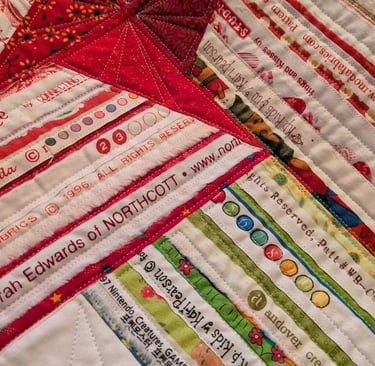
Passing your quilt top off to a longarmer can be nerve-wracking. You've invested both time and money in your top. It makes sense to do everything you can to ensure great longarming results. Proper preparation can save you not only stress, but money too, as your longarmer may charge you if they have to do tasks you could have done.
If you are used to quilting on your domestic sewing machine, be aware that preparing a quilt for longarming is a little different. Your longarmer will want to receive your quilt top, backing and batting (if you are providing all three) separately, not basted together. Here's the low-down on how to prepare.
Preparing the quilt top
If you want to end up with a nice square quilt that lays and hangs flat and straight, the first step is to make sure you have a square top before adding any borders. Block Party Quilt co. has a short, useful video about squaring up a quilt top. Equally important is to be very careful in adding your borders. Sharon Galna of Quiltish Corner has posted a great tutorial about avoiding wavy borders - I'd recommend studying it if you're not familiar with the method.
Before sending your quilt top to the longarmer, take a good look at it. Remove any loose or dangling threads, pet hair, or fabric scraps. To prevent fabric stretching or seams unraveling in handling, it's a great idea to sew a “victory lap” around the top - about ⅛ inch from the edge - to stabilize the edge.
Your finished quilt top should be neatly pressed. After pressing, I recommend loosely folding the top around the backing before packing for transit. Of course, even after the most thorough pressing and careful packing, some creases may be formed in transit. Most longarmers won't change for light pressing upon receipt to remove these creases, but you may be charged if significant time is required.
If you plan to add embellishments such as beads, buttons, charms or sequins to your quilt, it's crucial to wait until you get the quilt back from the longarmer. Most longarmers will not accept a quilt with embellishments that may damage their expensive machine.
Backing
In preparing backing to send to your longarmer, there are a few things to keep in mind. Longarming requires extra backing fabric on all sides of the quilt. Most longarmers will ask that the backing be about 10 inches larger than the top in both dimensions . So if your quilt is 60” by 60”, your backing will need to be at least 70” by 70”. If you are joining pieces of fabric by matching selvedges, be sure to leave enough seam allowance so that you can cut off the selvedges after joining and still have a half inch seam allowance to press open afterwards. This usually means sewing the two pieces together with at least a 1-inch seam allowance. If you care about pattern matching at the joining seam, you may need extra yardage for that. Press your backing before passing it off to the longarmer.
If you have the option, wide-back fabric can be an economical choice in some cases. Compare the price per yard of wide back fabric with buying twice as much regular fabric. If your quilt is extra large (king size), you might even need to join more than two lengths of standard fabric to get the needed size.
Some quilters like to use cuddle, or minky fabric for backing. This makes a nice, soft back. Check with your longarmer to make sure they are comfortable using this type of fabric, as it does take some care to avoid stretching.
An economical backing option can be new cotton sheets, if the area without seams is large enough. Low thread count works better than high thread count for longarming. Microfiber sheets should not be used.
Batting
If you are providing batting, rather than buying it from your longarmer, make sure to choose a quality, low loft quilt batting. 100% cotton batting without scrim does not work well on the longarm. Like the backing, your batting needs to be a bit longer and wider than your top. Most longarmers prefer it to be 8 to 10 inches bigger in both dimensions, just like the top.
Binding
If you are providing binding for your longarmer to apply to your quilt, there are a few things to keep in mind. Most quilters prefer a binding made from 2.25” or 2.5” strips, joined on the diagonal. Measure and add up the distance around your quilt, and do your math carefully! There's nothing worse than running out of binding when applying it to a quilt. Supply at least a few feet extra for easy joining. Your longarmer may offer options for binding. You may choose to have them fully machine bind the quilt, which provides a durable binding but does leave a stitch line on the back. Another option is for your longarmer to apply the binding to the front, so that you can later hand sew it to the back. This provides a more attractive front and back but takes hand sewing and may be somewhat less durable.
Labeling your quilt
Another consideration as you prepare to hand off your quilt is whether you want to include a label. I consider labeling the quilt to be an important part of the process. The label identifies the quilt-maker(s), and may also give additional information about the quilt pattern, the occasion for the quilt's creation, the recipient, and place and date of creation. Some longarmers may offer the option of creating a label for you, but even that case you will need to let them know what you would like the label to say.
One final bit of advice
Remember, you and your longarmer are a team with a common goal. You both want to produce a beautiful finished quilt. Don't be afraid to tell your longarmer what you'd like, or to ask questions. If your longarmer advises against doing something you request, it's OK to ask why, but take that advice seriously.